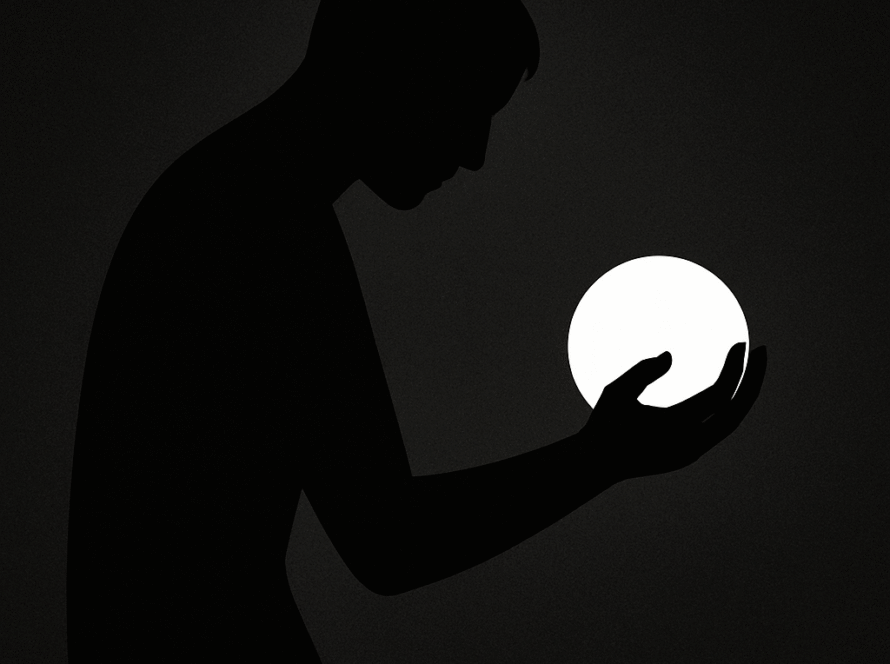
What We Carry Without Knowing
What is a new year, really? Not a fresh start. Not a blank page. A page that carries in watermark everything that came before, all the invisible layers of a life that accumulates without asking permission. I am writing these lines in the first nights of Ramadan, that time of year when one is invited to set down what weighs heavily, to finally see what one is, beneath everything else. What I see is an accumulation. And I decided to make it an article.
Ex nihilo nihil fit. Nothing comes from nothing. Parmenides had said it in the 5th century BCE with the dryness of a mathematical axiom. Lucretius echoed it with the same conviction in his De rerum natura: no force, divine or human, draws anything from pure nothingness. The formula is ancient. It remains disconcertingly modern. It says something fundamental about the nature of all creation, whether cosmological, artistic, spiritual, or entrepreneurial.
That something has a name. It is called heritage.
The Word Before the Thing
Patrimonium, in Latin. What comes from the father, pater. What one receives before even deciding to receive. But the word, if you truly listen to it, says more than material transmission. It speaks of a debt to what came before, a responsibility toward what comes after, and between the two, an effort: that of transforming inherited legacy into something one truly possesses.
Goethe, in Faust, poses this challenge with a precision that has long stayed with me: “Was du ererbt von deinen Vätern, erwirb es, um es zu besitzen.” What you have inherited from your fathers, earn it to truly possess it. Inheriting is not enough. One must work the inheritance through conscious effort, trial, sometimes suffering, for it to cease being a passive bequest and become a living possession. The entrepreneur, like any individual, who ignores his inheritances does not possess them. He is possessed by them.
And then Rumi. The Masnavi opens with the image of the ney, the reed flute, weeping since it was torn from its native reed bed. It sings, but it sings of separation. It is music, but it is memory. “Listen to the ney, how it tells a tale, complaining of separations.” This image may be the most beautiful the world’s literature has ever produced to say that we always carry within us the place we come from, the soil from which we were uprooted, even when we believe we have started over from nothing.
We never start over from zero. We start over from the ney.
The Heritage of Stone
Some heritages are read in stone before they are read in men.
The Taj Mahal, first. Shah Jahan had it built in the 17th century for Mumtaz Mahal, his wife who died in childbirth. Twenty-two years of construction, twenty thousand workers, white marble that changes colour with the light of day. It is not a mausoleum. It is a declaration: that love can cross death, that what one has received from another can be transformed into something eternal. The Taj Mahal is perhaps the most beautiful testimony humanity has ever produced of what one does with an emotional inheritance when one refuses to let it disappear.
In Marrakech, the Bahia Palace says something similar, on a different scale and in a different century. Ba Ahmed, grand vizier of the late 19th century, had it built for Bahia, his favourite wife, of whom he was desperately in love. Her very name means “the beautiful one.” Orange blossom gardens, zellige tilework of rare refinement, cedar ceilings that seem to hold through the sheer force of a desire to please. Love as architect. Love as heritage bequeathed to an entire city.
And then the Badi Palace, a few hundred metres away. The Saadian sultan Ahmad al-Mansour had intended it as a monument to his own glory, following victory at the Battle of the Three Kings in 1578. What remains today are ruins inhabited by storks, gutted columns, stretches of wall that time has slowly reclaimed. Glory built for itself does not last. Love built for another does.
And the ramparts, finally. Those ochre walls that encircle the medina like two arms closed around what they swore to protect. One photographs them, walks along them, sometimes forgets them in their very obviousness. Yet they have stood since the 12th century, silent and stubborn, having survived everything time has thrown at them. They remind us that some inheritances are not passed down through words or books, but through the simple tenacity of enduring. To protect what has protected us is perhaps the most humble and most noble form of heritage. The kind that does not seek to shine, but to hold.
These heritages of stone all say the same thing: every edifice is the inner portrait of the one who built it. Shah Jahan deposited his grief transformed into beauty. Ba Ahmed, his tenderness. Al-Mansour, his devouring ambitions. Stone does not lie. Long after the men have gone, it preserves the trace of what they carried within them. And if one looks at the ramparts through this same lens, one reads not merely a military strategy, but a collective psychology: the fear of the other, the need for boundaries, the desire to protect what one loves while sometimes confining what one believes one possesses.
The monuments precede us. But the men who built them resemble us. They too carried inheritances they had not always chosen.
What Others Carry Without Showing It
Ibn Arabi, the great Andalusian mystic born in Murcia in the 12th century, develops in the Futûhât al-Makkiyya an idea that overwhelms once one truly receives it: every human being is a unique epiphany, a particular manifestation of a cosmic inheritance he did not choose. We are all singular forms of a secret that precedes us. What we believe to be our free decisions is often the result of everything that has formed us, deformed us, wounded us, shaped us in the darkness of our most intimate history.
Marcus Aurelius, in his Meditations, practises this exercise with an almost stubborn regularity: understand men so as not to resent men. “Begin the morning by saying to yourself: I shall meet today with the meddlesome, the ungrateful, the arrogant, the deceitful. But they are so because they have not yet learned to distinguish good from evil.” This is not naivety. It is a hygiene of the soul that allows one to pass through without becoming weighed down.
Those who harm us almost never do so from a pure and fully free choice. They do so from a heritage, too. From accumulated wounds we cannot see, from ancient fractures that have shaped behaviours we endure without understanding their origin.
There are heritages that do not arrive through the front door. They seep in like damp into stone, until one discovers cracks one does not remember making. One believes one inhabits one’s own house, and then realises that certain rooms were furnished long before one’s birth, by hands one did not choose. The most troubling thing is not inheriting those rooms. It is finding them comfortable. Ibn Arabi teaches that consciousness is the light that allows one to walk through the entire house, to open the closed rooms, not to destroy them, but to see them. And to see what one carries is already the beginning of a freedom.
To understand this does not mean accepting the unacceptable. It means refusing to reduce a human being to the act he has committed, while lucidly protecting oneself from what destroys.
Rumi again, in one of his quatrains: “Outwardly, appearances divide. Inwardly, lights unite.” The suffering another projects onto us often comes from a light broken within him, long before he ever met us. To recognise this is a spiritual act as much as an intellectual one. It may be one of the most demanding forms of human greatness.
I am working on it. I do not claim to have arrived. But Ramadan is made precisely for this: to bring the being back to the essential, to set down what weighs, and to look with greater clarity at what one truly carries, and why.
Less Romantic: Transmitting as the Highest Form of Entrepreneurship
If nothing comes from nothing, then everything one builds becomes, in turn, someone else’s heritage.
Newton, with a candour rare for a genius of his calibre, had said it himself: “If I have seen further, it is by standing on the shoulders of giants.” Greatness lies not in the negation of the past. It lies in the capacity to synthesise it, to surpass it by acknowledging it. Steve Jobs did not invent the graphical interface from nothing. He saw it at Xerox PARC, absorbed it, digested it, transformed it. Every founder who believes he is starting from nothing forgets the invisible infrastructure that precedes him: the institutions that formed him, the markets others cleared, the mistakes others paid for in his place.
What I bring to 2026, I now know with a clarity that easy years do not provide: it is an accumulation. Founders I have accompanied who taught me that the essence of my work was not to give them resources but to help them see what they already carried without knowing it. Readings that shaped my way of thinking through systems before thinking through solutions. And a difficult year, finally. One of those that passes through you more than it passes by. Those who truly know me will read between the lines. The others do not need to know more than this: 2025 will not be erased. It will be transformed. Like everything else.
Ibn Arabi speaks of the silsila, that chain of spiritual transmission linking masters to disciples across generations. What is transmitted is not only knowledge. It is a quality of presence, a way of inhabiting reality, a light that passes from hand to hand without ever being exhausted. The entrepreneurial ecosystem works in the same way, even if one does not call it that. What pioneers deposited in a territory, in a city, in a generation, nourishes founders who will never know them. Heritage circulates in silence.
Entrepreneurship, seen this way, ceases to be an act of ego and becomes an act of responsibility. Not only toward clients, investors, teams. Toward those who will come. Toward the soil one is preparing without even knowing it.
In these first nights of Ramadan, I often return to this line from the Masnavi, which I read the way one returns to a spring: “You are not a drop in the ocean. You are the entire ocean in a drop.” All of humanity’s heritage, its wisdoms, its wounds, its impulses, its ruins, is held within every being. Within every founder who dares. Within every year one crosses, and that crosses one in return.
2026 is not a blank page. It is a page that carries in watermark everything I have lived, learned, lost and transformed. And that is precisely why it interests me.
Ex nihilo nihil fit. Nothing comes from nothing. We are all heirs to something. The question is not what. The question is what we will do with it.
This article was translated from French into English with the assistance of AI.